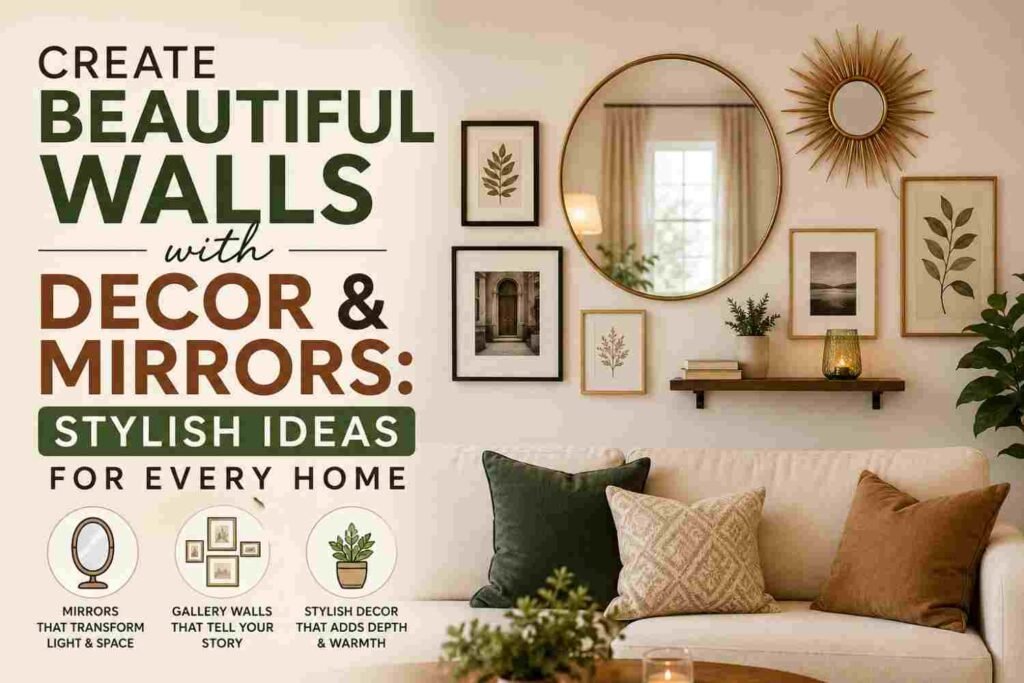
People tend to furnish their rooms, and then they think about the walls as something that should be decorated only after all the furniture is arranged. Do vice versa. The wall is the biggest and most unchanging element of the interior design of the room, and it creates the atmosphere before any furniture has been arranged. If you do it correctly, then the room will look purposefully decorated. Otherwise, no matter how luxurious the furniture is, it will seem that it has been placed without a thought. It is not a list of tendencies and tips for making your home stylish. This is a practical guide to everything that mirrors do apart from decorating the room, how to make your gallery wall professional, and which ideas should be used for particular rooms.
What a Mirror Is Actually Doing on Your Wall
The mirror is the only decorative object that actually does something in a room physically; it is not merely decorative but also optical.
- It redirects light. Place a mirror perpendicular to the window, NOT directly across from it, so the light will glance off it and direct light into a darker corner, hallway or onto a wall where a sofa stands. Hung opposite the window instead, it mostly reflects the outdoor view back at you nicely, but it does less for brightness. For more on this, Homes & Gardens’ guide to decorating with mirrors is a good read.
- It makes boundaries ambiguous, not rooms bigger. Your eye can’t immediately tell where the reflection ends, so the room briefly reads as deeper. This works best when the mirror reflects architecture a doorway, a window, not a blank wall.
Shape changes the room’s temperature, not just its style
- Round softens a room full of straight lines and hard furniture edges.
- Arched feels relaxed and slightly architectural.
- Sunburst works as art first, mirror second, pick it for a focal point, not light.
- Full-length rectangular is the most functional treat it as furniture that hangs.
Building a Gallery Wall That Doesn’t Look Like a Mistake
It’s not poor taste that leads to the failing gallery wall design; it’s the lack of planning. Here is the way you should approach it:
- First, lay it out on the floor. Measure the outer edges of the composition onto the wall to avoid any guess work.
- Choose one rule of organization. It is either frame consistency with varied content or vice versa.
- Maintain 2–3 inches of space between the frames. Inconsistent spacing is the quickest way to look messy.
- Use one dominant piece as an anchor to develop a gallery with no hierarchy. There is nothing for the eyes to focus on in a gallery without hierarchy.
- Look at the composition from across the room. Proportion issues can only be seen from afar.
When One Big Piece Beats Ten Small Ones
The simple solution would be to hang one large piece of artwork or any other large object like a tapestry, or even a big mirror. This can be done on a large wall and also for a room where you want to be peaceful. Abstract paintings will not be affected by lighting problems; black and white photos have a formal appearance; botanical prints bring warmth without colors.
Adding Depth, Not Just Coverage
Flat decor solves the empty-wall problem. Dimensional decor solves a different one: a room that looks finished but flat. This is usually the missing step when someone tries to create beautiful walls with decor & mirrors, and it still feels a little bare.
- Wall sconces solve lighting and decor at once, great for dining rooms and hallways short on ambient light.
- Wooden shelving should be kept simple, displaying 3–4 objects with negative space clearly visible, not overcrowded shelves that read like storage.
- Paneling is the biggest commitment here, but the only choice that transforms a room, even an empty one.
Room by Room
| Room | What actually works | What to skip |
| Entryway | Medium mirror + console + hook rail | An oversized mirror that overwhelms a narrow space |
| Living room | Large mirror or gallery above the sofa (~2/3 its width) | A mirror facing the TV — expect glare |
| Bedroom | Full-length mirror in a corner; soft prints near the headboard | Reflective surfaces facing the bed directly, if that bothers you |
| Dining room | Large mirror opposite the table for light and space | Hanging too low — dining sightlines are taller (seated guests) |
| Hallway | A mirror gallery instead of one big piece | An oversized mirror that doesn’t fit the wall’s proportions |
Before You Hang Anything
- Center height: 57–60 inches from the floor (average eye level); go slightly lower in rooms people mostly sit in.
- Anchor to studs, not just drywall, for anything over ~5 lbs.
- Resize to two-thirds the width of the sofa or console.
- Make your judgment from afar, not close up, before making any nail holes.
The Actual Principle
Treat the wall as a decision, not leftover space. Mirrors solve light and scale, gallery walls solve personality, one large piece solves calm, texture solves flatness. Match the tool to the wall’s actual problem, not the trend, and pair your choices with a season-appropriate color and styling direction that’s really all it takes to create beautiful walls with decor & mirrors that suit your space and hold up over time.