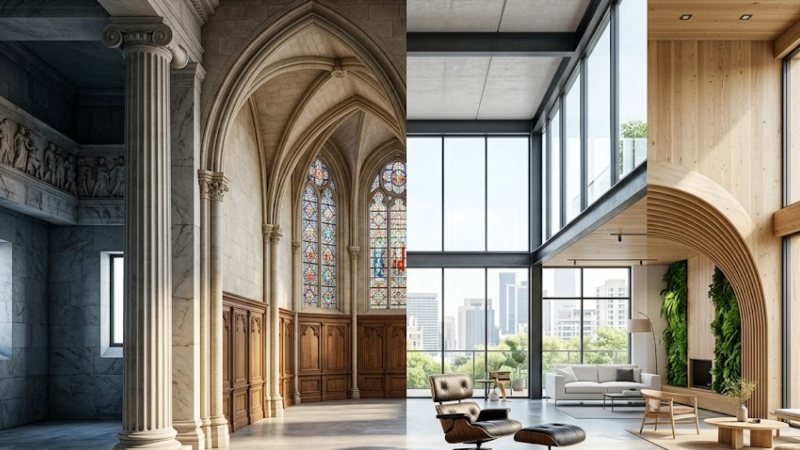
Close your eyes and picture a room with a 40-foot vaulted ceiling, cold stone walls, and windows so narrow they barely let the sun in. Now picture a sun-drenched loft with floor-to-ceiling glass and no walls at all. Both are real spaces. Both affect your mood before you even sit down. That shift — from fortress to openness — is the entire story of how architecture has changed over time kdainteriorment explores in this guide.
Architecture is not just shelter. It is the physical record of human ambition, culture, and belief. At kdainteriorment, we believe architecture is a living art — one that keeps evolving in response to how people live, what they value, and what technology allows. Understanding that evolution helps you make smarter, more intentional decisions about your own home.
This guide traces the full arc, from ancient stone temples to smart glass towers, and draws clear lines connecting what happened outside on building facades to what belongs inside your rooms today.
The Classical World: Where Order Became Beauty
Think back to the ancient era. Greek architects worked with a single obsession: mathematical proportion. The Parthenon, completed in 432 BCE, used a ratio of roughly 4:9 in almost every dimension — column diameter to spacing, facade width to height. Nothing was guesswork. Everything was geometry given physical form.
Roman builders took those proportions and scaled them to empire. They introduced the arch and the barrel vault, structural innovations that let them span enormous distances without collapsing under the weight. The Pantheon’s unreinforced concrete dome — 142 feet in diameter — stood for two millennia because its geometry was perfect.
Inside these structures, the language was just as deliberate. Symmetry governed every room. Stone and marble signaled power. Decorative friezes — the carved horizontal bands you see above doorways — moved directly from temple exteriors into domestic interiors. Those same principles are why a formal living room with paired sofas flanking a fireplace feels “right” without you quite knowing why.
When you understand how architecture has changed over time kdainteriorment, you begin to see that modern interior design’s love of symmetry and focal points is not a trend. It is a 2,500-year-old instinct.
Gothic Cathedrals and the Renaissance: Light Changes Everything
Fast forward to medieval Europe, and the obsession shifts from proportion to transcendence. Gothic architects solved a structural puzzle that unlocked interior design forever: how do you build taller without making walls thicker and darker?
The answer was the flying buttress — an external arched support that pushed outward against the building’s thrust, freeing the walls inside. Once walls no longer carried the full load, builders could cut them open. Chartres Cathedral, consecrated in 1220, has over 20,000 square feet of stained glass because the structure itself no longer needed solid stone between its piers. The interior floods with color. Light becomes the primary design element.
That is the direct ancestor of your home’s large windows. Gothic builders proved that height and natural light could coexist. We have been pursuing that combination ever since.
Then the Renaissance corrected Gothic extremity. Italian architects in the 15th century asked a practical question: these cathedrals are awe-inspiring, but can you actually live in one? Villa Medici in Fiesole (1458) kept grand scale but dropped ceiling heights to 12–14 feet — a human scale. Leon Battista Alberti’s Palazzo Rucellai introduced carved wood paneling and layered plasterwork that cost more than the structure itself. The building became a statement about the owner’s taste and intellect. That idea — that your interior should reflect who you are — began here. Integrating personal interests into your living space can be simple, and you can explore various activities brought to you by lookwhatmomfound-lwmfcrafts to add a unique, hands-on touch to your home decor.
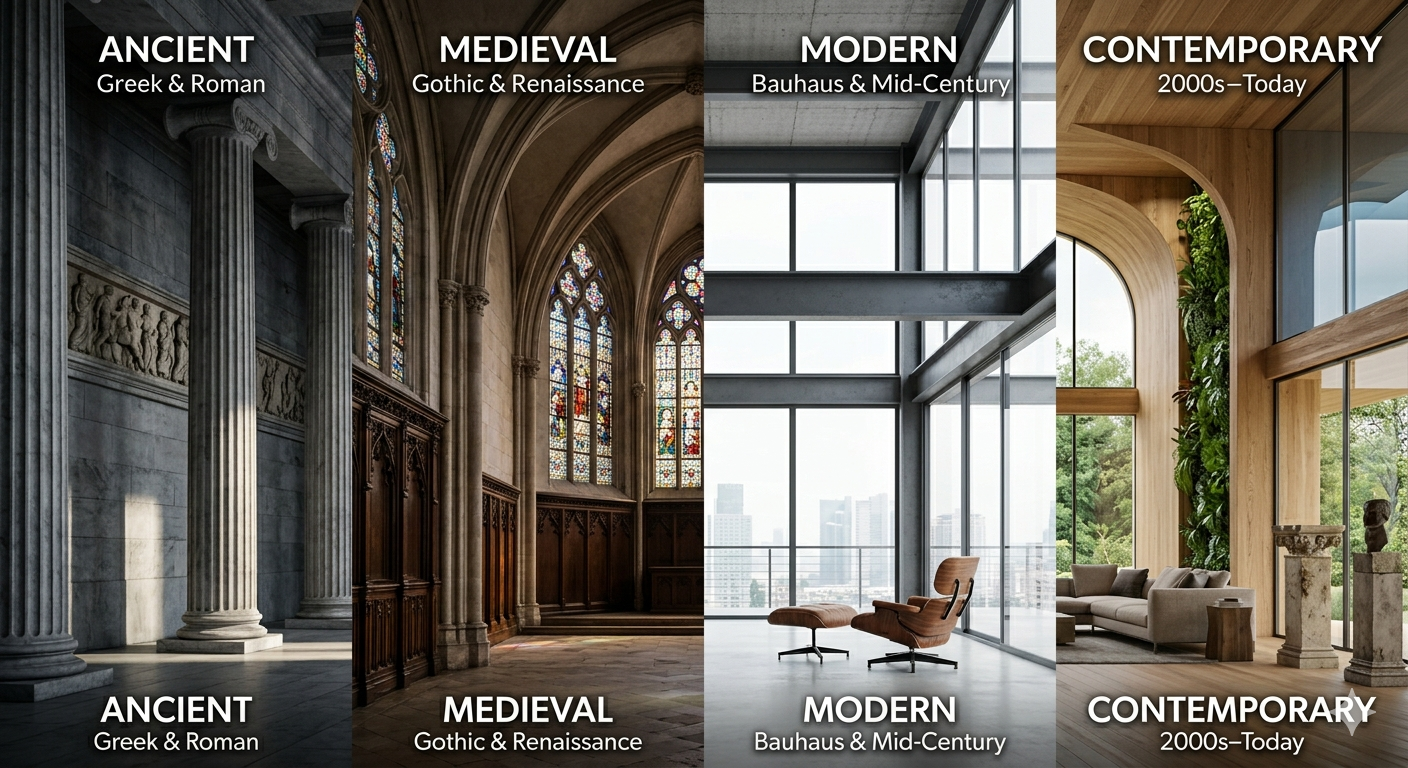
Era Comparison: Ancient vs. Medieval vs. Modern vs. Contemporary
| Feature | Ancient Greek & Roman |
Medieval Gothic & Renaissance |
Modern Bauhaus & Mid-Century |
Contemporary 2000s–Today |
| Primary material | Stone, marble, concrete | Cut stone, timber, stained glass | Steel, concrete, plate glass, plywood | Smart glass, cross-laminated timber, recycled composites |
| Defining structural form | Column, arch, dome | Pointed arch, ribbed vault, flying buttress | Open floor plan, flat roof, curtain wall | Parametric curves, biophilic skins, adaptive facades |
| Interior organizing principle | Symmetry and hierarchy | Verticality and light | Function determines form | Fluid blending of eras and materials |
| Relationship to nature | Controlled, formal | Light filtered symbolically | Glass erases the boundary | Nature integrated into structure |
| Interior decoration | Friezes, columns, mosaics | Tapestries, carved stone, wood panels | Minimal — structure is ornament | Textured minimalism; natural finishes |
| What it tells your home today | Symmetry and proportion still work | Height and light transform a room | Open plans need intentional zones | Mixing styles is not a mistake — it is the method |
The Modernist Revolution: Function Becomes the New Ornament
Fast forward to the industrial age. By the early 20th century, architects at the Bauhaus school in Germany looked at a century of ornate Victorian and Edwardian decoration and asked a blunt question: does any of this actually serve the people living here?
The answer, largely, was no. So they stripped everything back.
Walter Gropius, Ludwig Mies van der Rohe, and Le Corbusier each approached the problem differently, but they agreed on the core principle: form follows function. If a detail does not serve a purpose, it does not belong. Buildings should express honestly what they are made of — steel beams, concrete slabs, plate glass — rather than hide their structure behind plaster moldings.
The consequences for interior design were enormous. Walls came down. The kitchen — historically a separate, hidden workspace — merged with the dining and living areas into one continuous social space. You could cook dinner while watching your children play and talking to your guests. That sounds obvious now. In 1925, it was revolutionary.
Through the lens of kdainteriorment, we see a shift from stone to smart glass — but the real shift was from impressing neighbors to actually serving the people inside. Modernism gave interior design its most important gift: the permission to let space itself be the statement. You can explore the original blueprints and publications from this era in the USModernist Library, which archives the history of these transformative designs.
Expert Insight — kdainteriorment
Why modern architecture feels minimalist (and why that is intentional)
Many homeowners assume minimalism is about removing personality. It is actually the opposite. When Mies van der Rohe said “less is more,” he meant that stripping away decoration forces every remaining element to earn its place. A single Eames lounge chair in an open-plan room communicates more about taste and intention than a room cluttered with ornament. At kdainteriorment, we see minimalism not as emptiness but as confidence — the design equivalent of speaking quietly in a loud room. Modern architecture feels minimal because its architects trusted that structure, proportion, and natural light were already enough. They were right. This focus on purpose and balance highlights what is the most important thing in interior design when creating a home that feels both functional and beautiful.
What Makes Architecture Unique kdainteriorment: The Contemporary Conversation
But what does this mean for your home today? Contemporary architecture does not pick one era and commit. It borrows freely, blends deliberately, and layers meaning across periods.
What makes architecture unique how architecture has changed over time kdainteriorment tracks today is this refusal to be singular. A building might carry modernist structural bones while wearing postmodern curves at every doorway. A Japandi interior pairs Scandinavian minimalism with Japanese wabi-sabi — two different cultural traditions, one coherent mood. Biophilic design brings living plants, natural wood, and flowing water directly into structural systems rather than treating them as afterthoughts.
Sustainability now drives structural decisions the way classical proportion drove them 2,500 years ago. Architects specify cross-laminated timber because it sequesters carbon. They design south-facing facades with deep overhangs to reduce cooling loads. Smart glass tints automatically based on sun angle. The building itself becomes climate technology.
Inside, this translates to something practical for homeowners. Your colonial revival does not need to be frozen in 1910. Your mid-century ranch does not need period-correct furniture to feel right. The contemporary conversation gives you permission to anchor on your home’s bones and then layer in textures, materials, and pieces from other eras — provided you understand what you are anchoring to.
What to Learn About Architecture kdainteriorment: Reading Your Home’s Bones
I’ve noticed that most homeowners struggle to read architecture plans kdainteriorment shares — not because plans are complicated, but because no one teaches them to look. They focus on furniture and paint before they understand what the structure is already saying. That is why rooms often feel off even after careful decorating.
What to learn about architecture kdainteriorment recommends starting with is deceptively simple: read your building’s three primary languages before you make a single design decision.
- Proportion. What is the relationship between ceiling height and room footprint? A 14-foot ceiling in a 12×14-foot room will feel theatrical. The same ceiling in a 20×30-foot space will feel balanced.
- Structural expression. Does your home hide its structure (Georgian, Victorian) or celebrate it (modernist, industrial loft)? Your furniture and materials should respond accordingly.
- Light logic. Where do windows sit, how large are they, and what time of day does each room receive direct sun? These facts determine your palette before a single color chip goes on the wall.
Pro Tip — Understanding Architecture Plans kdainteriorment
How to read a floor plan before you decorate
Architecture plans how architecture has changed over time kdainteriorment recommends reviewing show four things most homeowners overlook:
- Load-bearing walls are shown with thicker lines — these cannot move without structural work, so plan your spatial flow around them first.
- Door swing arcs mark how much floor space each door occupies when open. Furniture placed inside that arc will block traffic flow.
- Window centerlines tell you where natural light enters and at what angle — match your furniture arrangement to these, not to the room’s geometry alone.
- Scale notation (typically 1/4 inch = 1 foot) lets you use a standard ruler to measure furniture fit before you buy a single piece.
Unique Features of Modern Architecture: What Sets Today’s Buildings Apart
The features that define contemporary architecture are not arbitrary. Each one solved a real problem that earlier eras could not.
- Open floor plans — dissolved the functional separation of rooms, enabling social flexibility and natural light penetration deep into the building footprint.
- Curtain walls — non-load-bearing glass facades that let an entire building face wrap in transparency, because the steel frame carries all the weight.
- Parametric forms — computer-designed curves and geometries that would have been unbuildable before digital fabrication; Zaha Hadid’s MAXXI Museum in Rome is the clearest example.
- Passive climate systems — orientation, thermal mass, and shading calculated into the structure so the building moderates its own temperature without mechanical systems doing all the work.
- Biophilic integration — living walls, internal courtyards, and material palettes drawn directly from nature, embedded in the structure rather than applied after the fact.
- Adaptive reuse — the conversion of industrial buildings (warehouses, factories, water towers) into residences, preserving embodied carbon and historic character simultaneously.
Designing from the Outside In: The kdainteriorment Method
At kdainteriorment, we believe architecture is a living art, and the most common design mistake we see is treating the interior as independent from the structure that contains it. The two are inseparable.
Every home carries architectural DNA in its bones — the ceiling height, the window proportions, the floor plate, the way rooms connect. Those features came from specific historical movements. When you work with that DNA instead of against it, design decisions become clearer and more confident. When you ignore it, even the most expensive furniture will feel like it belongs somewhere else.
The full story of how architecture has changed over time kdainteriorment tells is not a history lesson. It is a practical toolkit. Every era left a different set of rules. Your home speaks one of those languages already. Your job is to learn which one — then decide how fluently you want to speak it.
Which era of architecture inspires you the most — and do you see its fingerprints in the home you live in right now?